


Franciscan Gospel Reflection for the 21st Sunday of Ordinary Time 2026 is here for your prayer. Who are your rocks, the people in your life who have helped you sort out some of life’s quagmires?
The Gospel background and reflection questions are prepared and distributed by Franciscan Sister of Christian Charity Sister Anne Marie Lom, OSF and Joe Thiel, as edited from Reflections authored by Fr. Paul Gallagher, OFM. The excerpts from the Sunday readings are prepared by Joe Thiel. To read or download the complete pdf with excerpts for your prayer, please click here: Franciscan Gospel Reflection August 23 2026

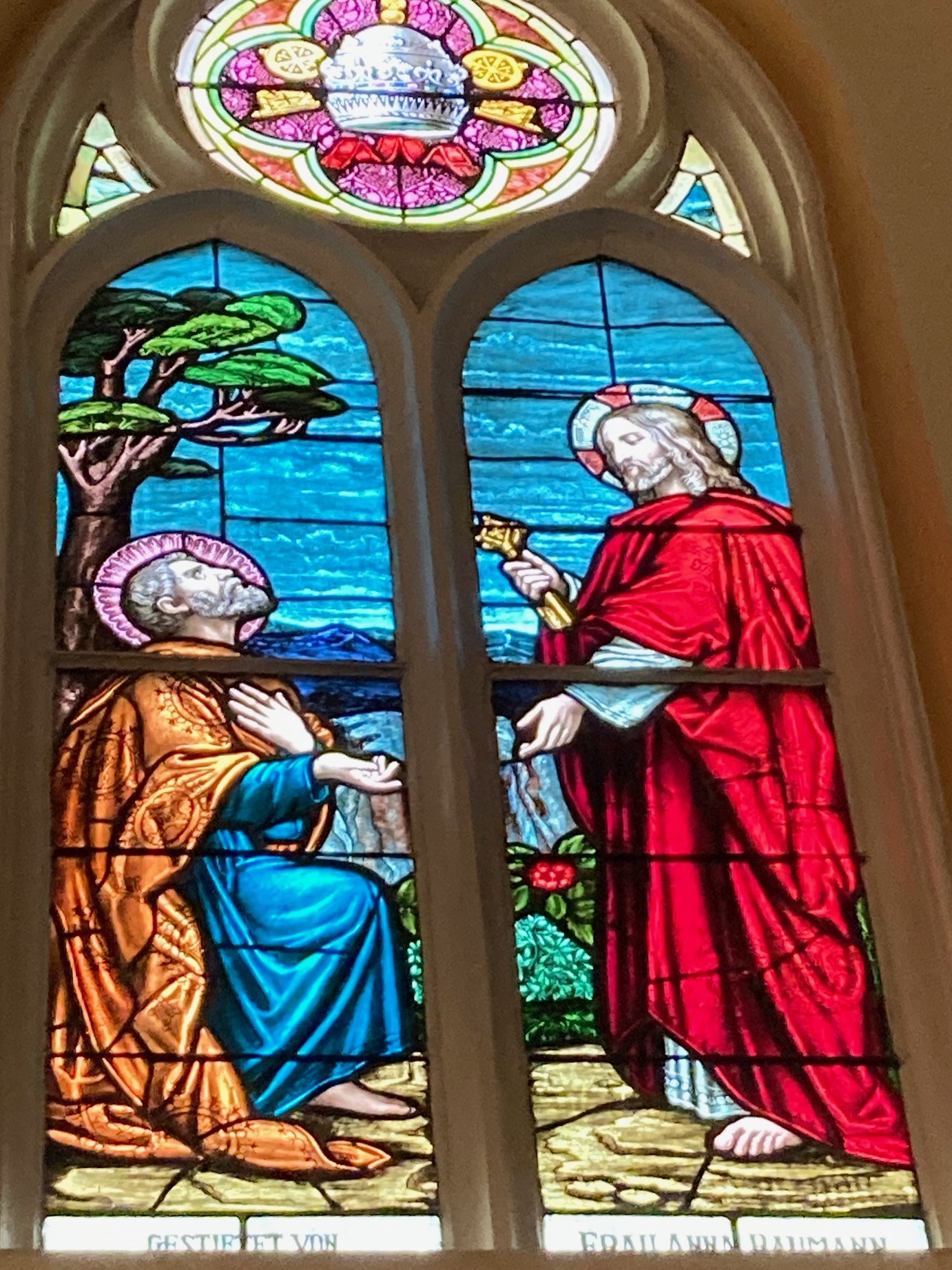
Photos: Franciscan Sisters of Christian Charity; St. Michael Church, Whitelaw, Wisconsin
Matthew 16:13-20
When Jesus went into the region of Caesarea Philippi he asked his disciples, “Who do people say that the Son of Man is?” They replied, “Some say John the Baptist, others Elijah, still others Jeremiah or one of the prophets.” He said to them, “But who do you say that I am?” Simon Peter said in reply, “You are the Messiah, the Son of the living God.”
Jesus said to him in reply, “Blessed are you, Simon son of Jonah. For flesh and blood has not revealed this to you, but my heavenly Father. And so I say to you, you are Peter, and upon this rock I will build my church, and the gates of the netherworld shall not prevail against it. I will give you the keys to the kingdom of heaven. Whatever you bind on earth shall be bound in heaven; and whatever you loose on earth shall be loosed in heaven.” Then he strictly ordered his disciples to tell no one that he was the Messiah.
Background:
The Gospel from last week described Jesus’ encounter with a Canaanite woman in the pagan region of Tyre and Sidon. Following that exchange, Matthew reports that Jesus returned to the Jewish region and the shores of the Sea of Galilee. Great numbers of people followed him into the mountains, where he cured many. After the crowd had been with them for three days, Jesus once again told the disciples to give the people something to eat. They had only seven loaves and a few fish. Jesus had the crowd recline on the grass, and he blessed the bread and had the disciples distribute it to the crowd. Then he had them collect what was left – seven baskets full of leftovers this time, from the crowd of 4,000. When the crowd was dismissed, Jesus and the disciples made their way in a boat to the district of Magadan, where he encountered some Pharisees and Sadducees. They asked him to produce some sign from heaven. Jesus left them without responding to their request. When they got to the other side of the sea, Jesus told the disciples to beware of the leaven of the Sadducees and Pharisees. The disciples had forgotten to bring bread for the trip, and they presumed Jesus was talking about the leaven for bread. Jesus made it clear that he was speaking of the leaven of the Sadducees and Pharisees’ teaching. All this leads to the Gospel text for this week.
Similar to this week’s Gospel from Matthew, Mark’s Gospel too recounts an occasion when Jesus
asks the same questions that are posed here (Mark 8:27-29). In Mark’s account, Peter confesses that Jesus is the Messiah, but not that he is “the Son of the Living God.” Also, Jesus does not comment on Peter’s profession of faith, but he tells the disciples not to speak to others of what they have heard. Then Jesus speaks to them for the first time of his passion and death. Peter, hearing this for the first time, responds by taking Jesus aside and voicing some objection to what Jesus is saying. Jesus replies by telling Peter to “Get behind me, Satan, you are not thinking as God does, but as human beings do (Mark 8:33b).” Mark’s account is powerful, but the reader will benefit from keeping the two accounts separate. Matthew’s account, the Gospel text for today, represents a very different perspective into Jesus’ ministry and its own invitation for our response.
It will also be helpful to be aware that people of Mediterranean cultures have a very different sense of themselves than most westerners. They are “other-orientated” to the extent that they may not have a sense of who they are apart from their family or clan. From this perspective, Jesus is not quizzing his disciples to see if they know his true identity. His questions are an effort to sort out for himself who he is. While this way of thinking is very different from what many of us are accustomed to, there are examples of this mindset throughout the Gospels. In John’s Gospel, those who question Jesus are satisfied to learn that he is from Nazareth. Nathanael represents their attitude when he asks, “Can anything good come form Nazareth?” (John 1:46) In both Matthew and Mark, Jesus is identified as the son of a craftsman (Matthew 13:55 and Mark 6:3). Lastly, the Gospels portray an attitude that if you know one’s family, you know the person. “Is not his mother called Mary? And are not his brothers James and John and Simon and Judas? And are not all his sisters with us? Where then did this man get all this? And they took offense at Jesus.” (Matthew 13:55-57)
Hopefully, these passages help to highlight a different kind of understanding that people of Jesus’ day perceived of themselves and their identity. The more appreciation of the culture in which the Gospels were written, the deeper insight we get for ourselves and our culture.
Reflection Questions:
- Have you been through times when you were searching for direction or discovered you were not happy with the direction your life was heading?
- Who are your rocks, the people in your life who have helped you sort out some of life’s quagmires?
- Has anyone ever made a comment to you about yourself that revealed that they saw you in a different light than you saw yourself? What feelings arose from those experiences?
- If you were one of the disciples and Jesus asked you who people say he is, what would you think of Jesus asking you this? What feelings would you have at even being asked?
- How would you respond?
- In this Gospel Jesus says to Peter: “Blessed are you, Simon son of Jonah. For flesh and blood has not revealed this to you, but my heavenly Father. And so I say to you, you are Peter, and upon this rock I will build my church, and the gates of the netherworld shall not prevail against it. I will give you the keys to the kingdom of heaven. Whatever you bind on earth shall be bound in heaven; and whatever you loose on earth shall be loosed in heaven.” How do you think Peter is feeling as Jesus says these things?
- Can you also hear Jesus saying something similar to you? How do you feel, considering that Jesus looks upon you with similar feelings?
- Can you take time now to talk with God about how you see God working in the world today, or how he is working in your own life? What questions would you like to ask? Are there questions God might like to ask you?
The post 21st Sunday Franciscan Gospel Reflection appeared first on Franciscan Sisters.