


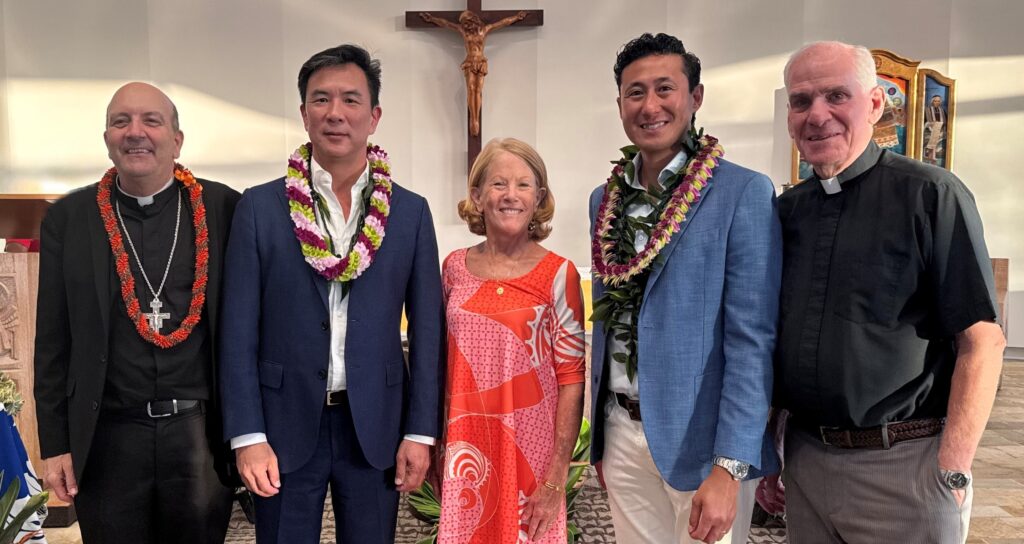
(L-R) Bishop of Honolulu Michael Castori, Louis Kim, CUH President Lynn Babington, Kyle Ballarta, Fr. Martin Solma
As artificial intelligence changes how students learn, work, and understand the world, Marianist educators face a question that no technology can answer for them: What kind of people are we preparing our students to become?
That question was a focal point of a lecture at Chaminade University of Honolulu (CUH) on Sunday, Oct. 18. Guest speakers included technologist and venture capitalist Kyle Ballarta, whose work includes technology initiatives with Vatican institutions, and Louis Kim, a former Hewlett-Packard executive now pursuing a Master of Divinity at Duke University.
Interest extended well beyond the evening lecture. Ballarta and Kim also participated in a Wellness Week panel discussion attended by more than 200 CUH students.
Across Chaminade, the University of Dayton and St. Mary’s University, the goal for educators, leaders, and students is a shared responsibility: helping students develop the judgment to decide when AI serves human flourishing—and when its use undermines the very learning and relationships that education exists to nurture.
For Fr. Marty Solma, rector and vice president for mission at CUH, faith offers a way to engage that responsibility without surrendering to fear or enthusiasm. “What our faith provides is a lens of discernment: what empowers and enhances human dignity and what diminishes it?” he asks. “What works for the Common Good and what is twisted for economic, political, or personal gain? What builds up and what destroys?”
Those questions belong wherever students encounter AI: in a writing assignment, a research project, a business decision, or the design of a new technology.
Lance Askildson, provost and senior vice president of academic affairs at CUH, sees an opportunity to reconsider what assignments actually ask students to demonstrate. When a machine can produce a polished essay, educators must look more closely at the thinking behind the finished product. “Instead of just policing AI tools, we should also be redesigning learning experiences that cultivate greater analysis, moral reasoning, and the capacity to wrestle with ambiguity,” he says.
That could mean asking students to explain their reasoning, critique an AI-generated response, or examine the assumptions behind an answer. The goal is to make students accountable for their understanding while preparing them to question the technology itself.
At University of Dayton (UD), that work begins with room for honest disagreement. Faculty and students bring different experiences and concerns to AI, including academic integrity, intellectual property, and the danger of allowing a tool to do too much of their thinking.
Ryan Allen, executive director of UD’s Learning Teaching Center and Center for Online Learning, believes those perspectives belong in the conversation. “Our role isn’t to push a particular technology. It’s to create space for reflection and discussion,” he says.
UD created an AI Steering Committee to connect that dialogue to the university’s responsibility to form leaders. It states: “Our Catholic and Marianist traditions don’t just call us to consider human dignity; they demand that we center it.”
Doing so requires asking who benefits from innovation, whose needs are overlooked, and whether greater efficiency comes at someone else’s expense.
At St. Mary’s University, students themselves are helping articulate that vision. Juan Marco Saca Dada, a student pursuing a combined bachelor’s degree in computer science and master’s degree in cybersecurity, advocates bringing theology, philosophy, science, business, and the social sciences into AI education. “Maintaining a faith-based approach, Marianist universities can help students realize all individuals are valuable and knowledge should be used to benefit others, especially the most disadvantaged,” he says.
His perspective connects technical competence with a larger purpose: students should leave college prepared to build and use technology responsibly, with an understanding of the people their decisions will affect.
Yet thoughtful discernment takes time in a culture that rewards speed.
Dr. Allison Leigh, executive director of the Association of Marianist Universities, points to the language within the Characteristics of Marianist Universities: “discern carefully,” “rigorous analysis,” and “prudent consideration.”
“These actions take time. They do not happen overnight or without collaboration,” she says. “They are an invitation to slow down, to pray, to collaborate, and to sit with difficult questions.”
In November 2025, Micah Alcisto, then a senior at Marianist-sponsored Saint Louis School in Honolulu, took his questions about AI directly to Pope Leo XIV during the National Catholic Youth Conference. The Pope urged young people to protect their capacity for independent thought and personal growth. “Remember: AI can never replace the unique gift that you are to the world,” he told them.
Pope Leo XIV developed that distinction in his encyclical Magnifica Humanitas, explaining that AI can imitate aspects of human intelligence but possesses neither moral conscience nor the spiritual depth through which people grow in wisdom.
From university lectures to high school classrooms, Marianist institutions are answering a vital call: to nurture the understanding, faith, and conscience that technology cannot replace.
Click here to explore a book published this past August titled Curiosity for the Common Good: A Catholic and Marianist Approach to Artificial Intelligence. It is available to download in PDF form for free or can be purchased as a book. You can also click here to watch a recorded livestream of the Marianist lecture at CUH on Facebook.
In The News
Historic First for UD
A new chapter awaits the University of Dayton (UD): Dr. Darlene Weaver has been named its 20th president, becoming the first woman to lead UD in its 176-year history.
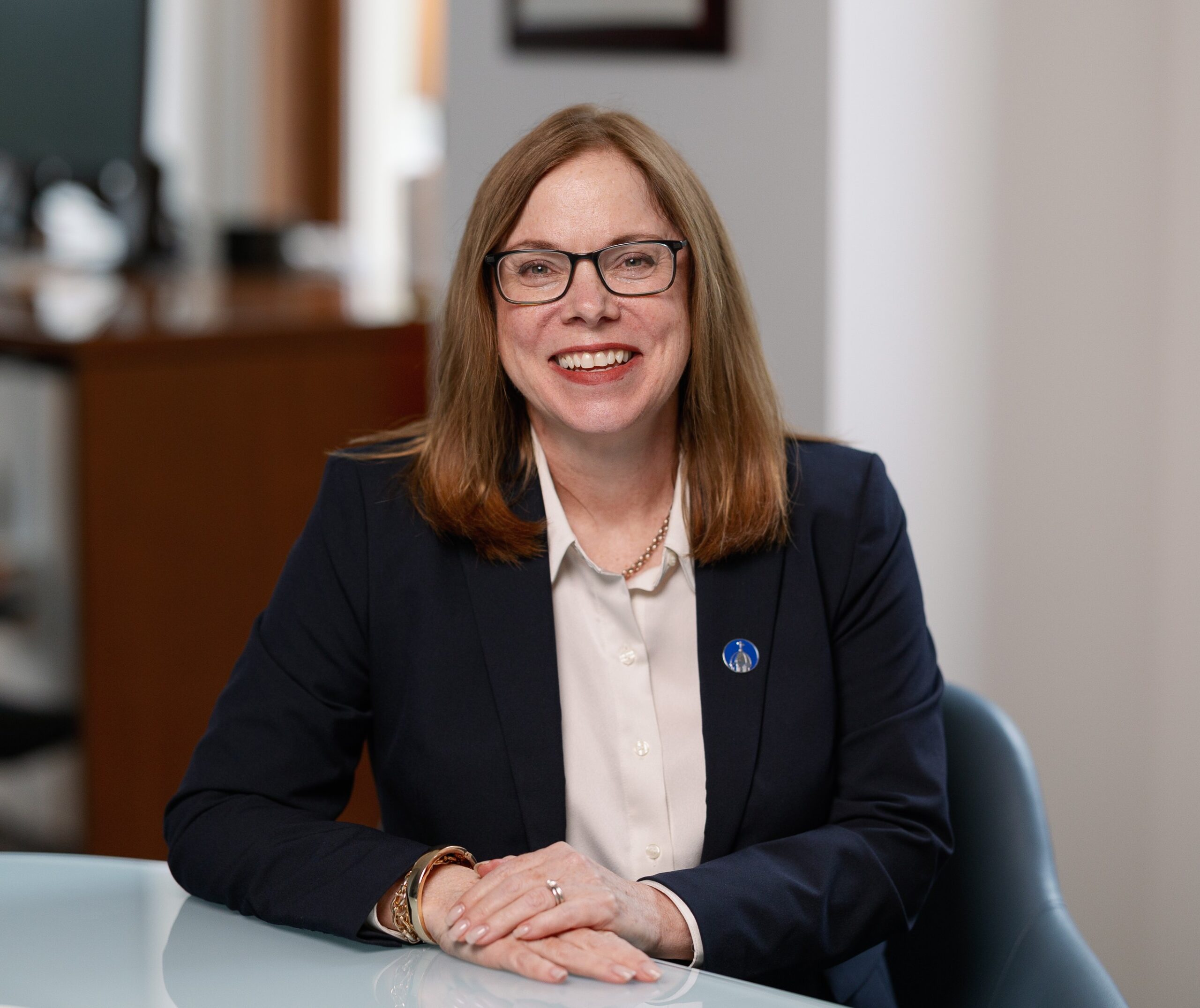
Currently UD’s provost and executive vice president for academic affairs, Weaver will begin her presidency July 1, 2027.
She brings decades of experience in Catholic higher education. Before joining UD in 2023, she served as associate provost for academic affairs and professor of theology at Duquesne University and held teaching positions at Villanova and Georgetown universities.
At UD, Weaver has championed initiatives that strengthen student advising, expand hands-on learning, and support faculty research—helping students connect their education with lives of purpose and service.
“In a world shaped by technological change, social division, and questions about the value of higher education, the University of Dayton has a distinctive role to play in serving the common good. We educate students not only for professional success, but for lives of meaning, responsibility and service,” Weaver said.
Weaver will succeed President Eric F. Spina, who retires June 30. The Province extends heartfelt gratitude to Dr. Spina for his many years of dedicated service and work to strengthen the university and its community. His commitment to students and to the values at the heart of a Marianist education will continue to inspire generations.
Paul Haught, the UD’s vice provost for faculty, graduate, and professional education, will become the interim provost, effective Nov. 1, while Weaver begins her transition to becoming UD president. Click here to read more.
Soaring to New Heights
More room offers more possibilities at Chaminade College Preparatory in West Hills, CA, where a $66 million campus transformation will give students around five acres of additional space to learn, compete, and grow in the Marianist tradition.
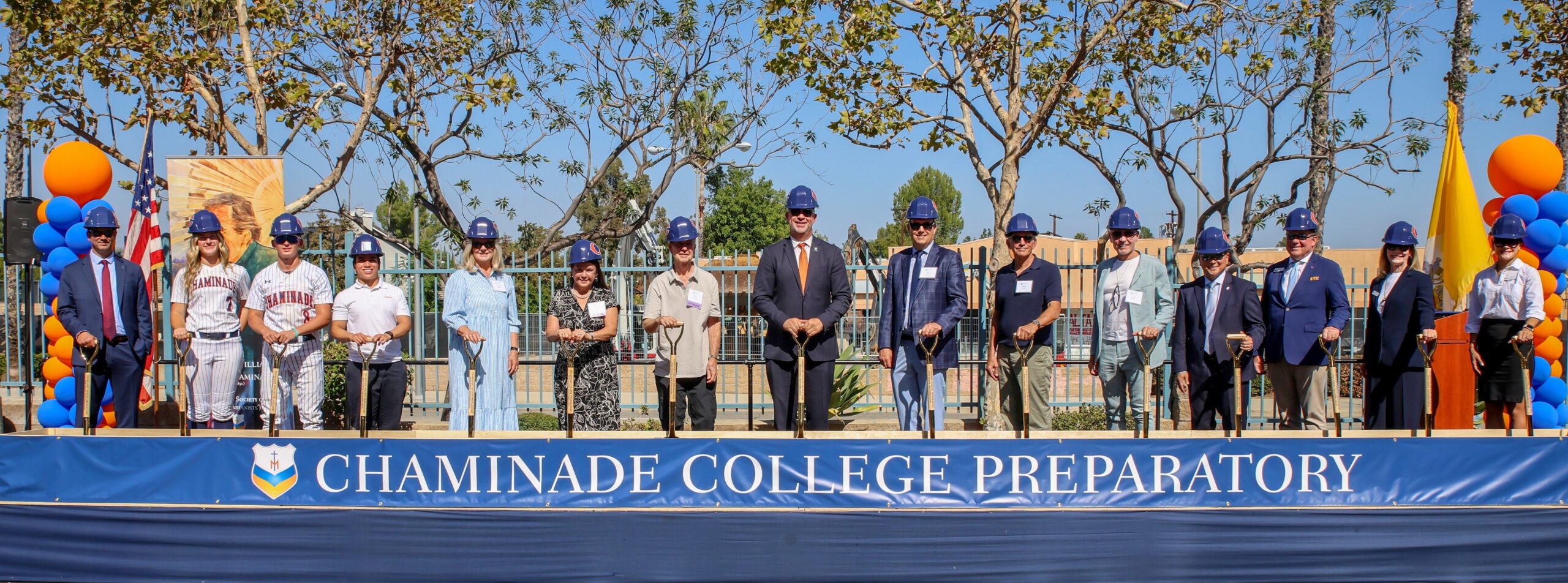
The school broke ground Sept. 30 on one of the largest capital investments in its nearly 75-year history. The project will add athletic facilities, a pedestrian bridge, a centralized student services center, and a college-style outdoor quad.
“Every element of this project was thoughtfully designed to support the growth and success of our students while advancing our Marianist mission of preparing young people to love, learn, and lead,” said Robert S. Webb, president of Chaminade College Preparatory.
A pedestrian bridge will connect the North and South campuses, providing a safer route to the new Fritz B. Burns Foundation Welcome and Student Services Center. The center will bring counseling, wellness services, a library, classrooms, and administrative offices together in one location.
A new baseball stadium will also accommodate practices for other field sports and allow the girls’ softball team to return to campus on the existing field. Meanwhile, the former Marianist Community House will become an Advancement and Alumni Center, offering space for community events.
The phased project is expected to be completed in August 2030. Chaminade will remain fully operational throughout construction as it builds on a mission that has shaped generations of students since its founding by the Marianists in 1952.
Click here to read the press release. Click here for a fact sheet of details. Click here for project renderings.
Making Room for Remarkable
A new classroom in Dublin, Ireland, is opening more possibilities for students to learn and thrive at St. Laurence College, a Marianist secondary school and member of the Le Chéile Schools Trust.
Ireland’s Minister for Health Jennifer Carroll McNeill with students
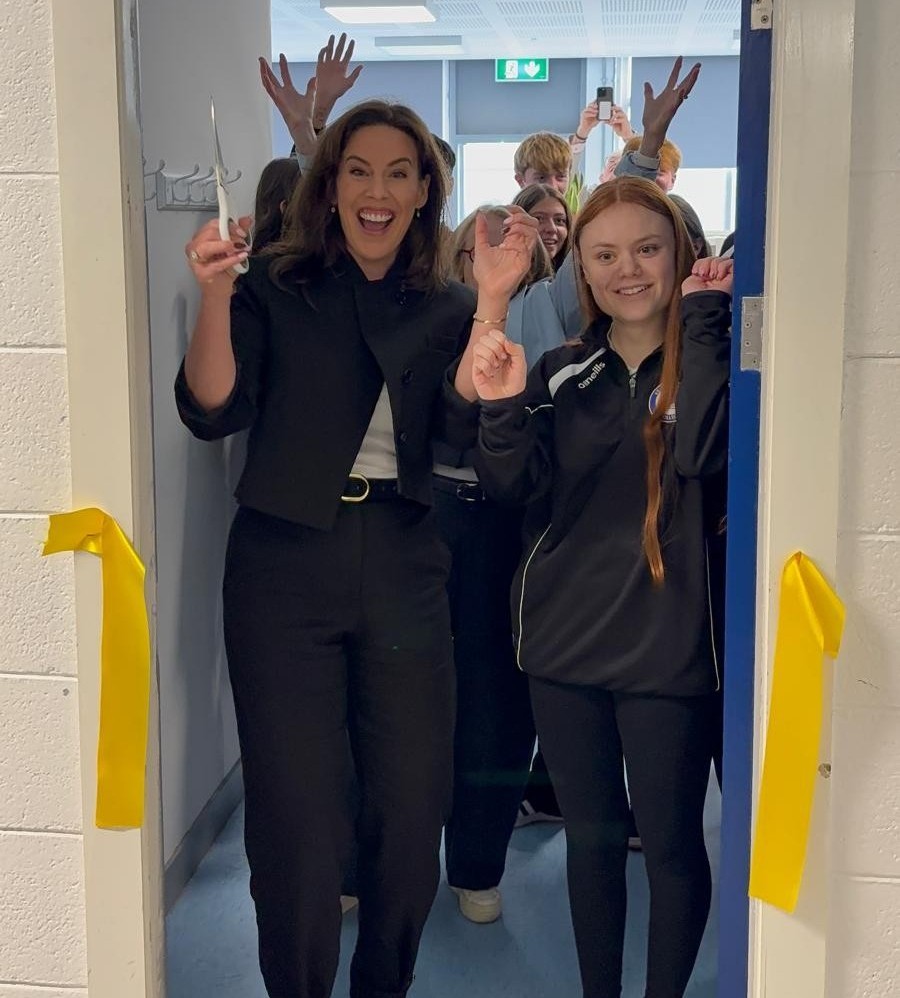
Ireland’s Minister for Health, Jennifer Carroll MacNeill, visited the school on Oct. 2 to officially open its new Autism Special Class. The classroom provides a welcoming environment with tailored support to help each student reach their potential and participate fully in school life.
The new space is the school’s fourth special education class, with five planned—part of an ongoing commitment to inclusive, accessible learning that currently caters to six students. During her visit, the minister met with the school community and answered questions from Politics and Society students about her responsibilities.

Rooted in the Marianist commitment to educating the whole person, this investment puts belonging into practice: recognizing each student’s gifts and providing the support to help them thrive.
That same spirit comes alive in “What Is It Like to Be a Marianist?,” a contemplative essay written by a 6th-year student (senior in high school). “We disagree. We argue. There are days when we fail to see eye to eye…It is about recognising that every person around me is worthy of love and care, regardless of who they are or what they believe,” Sochikayima Mbaneme writes. Her words capture the essence of our charism. Click here to read her full, thought-provoking and inspiring reflection.
✨Service Spotlight 🔦
Serving More Than Just Spaghetti
Spaghetti, meatballs, garlic bread—and a little muscle to move furniture. For seniors at Archbishop Daniel J. Gross Catholic High School, putting faith into action can look as simple as stepping into a kitchen and asking, “How can we help?”
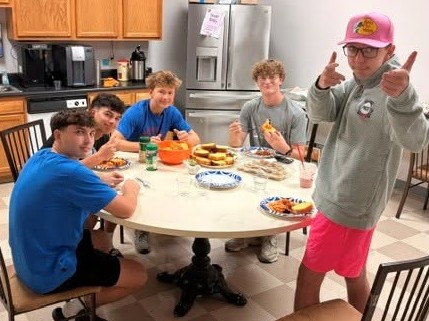
Students from the Marianist school in Omaha, NE, are bringing their time, energy and cooking skills to Guiding Grace, an organization that helps parents and families facing unexpected pregnancies and economic challenges build lasting stability. Shared meals are part of its evening classes, offering an opportunity for nourishment and connection.
In a social media post, Guiding Grace celebrated seven seniors who recently prepared dinners. “We can’t wait to meet more of these students as the year goes on!” Guiding Grace shared.
A group of other seniors spent time volunteering at the Heart Ministry Center this month. From packing pantry items inside to pushing shopping carts and loading fresh food directly into vehicles for local families, these students jumped right in to serve.
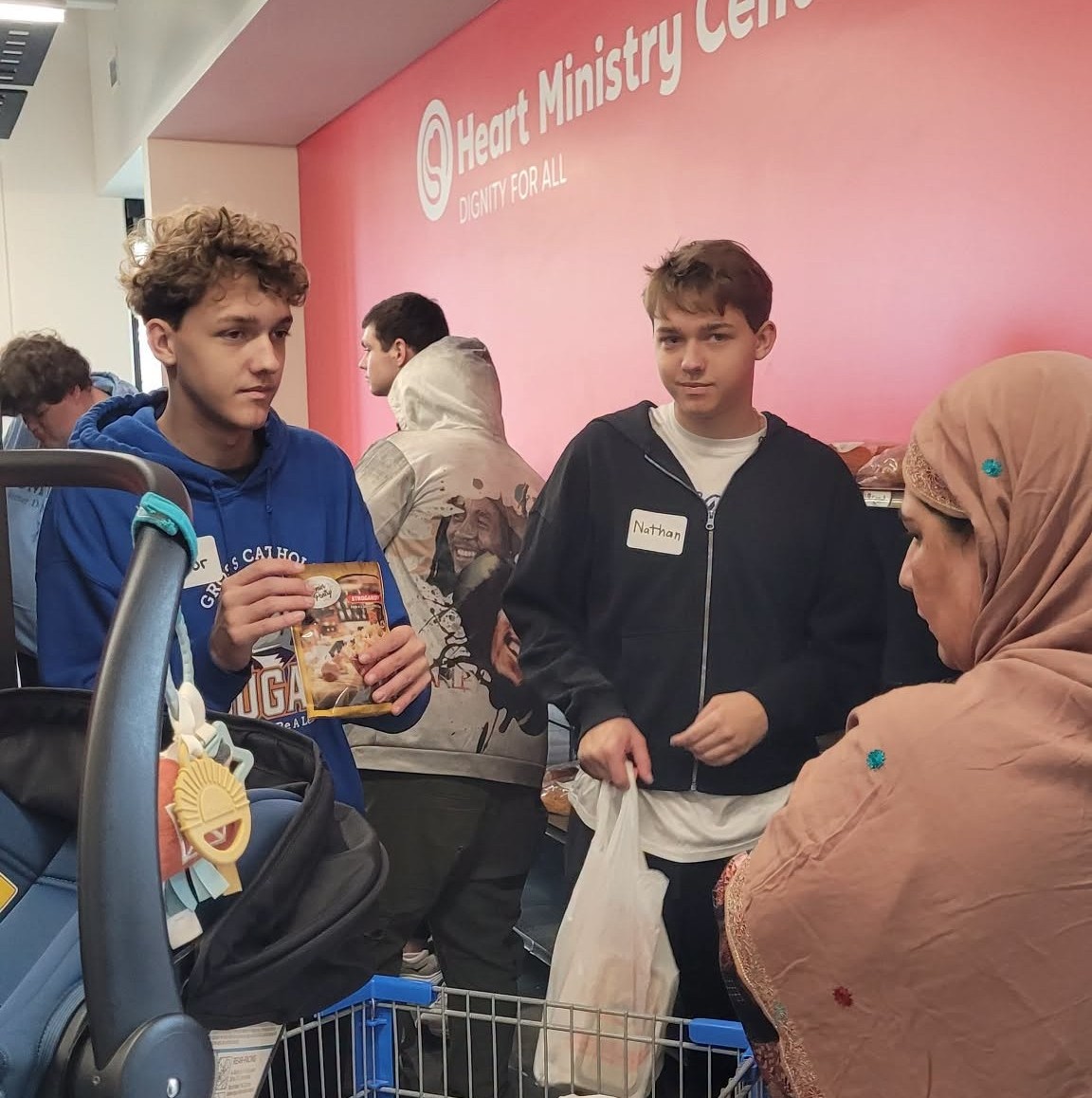
The students’ service brings the Corporal Works of Mercy to life. Feeding the hungry becomes a meal prepared with care. Supporting a neighbor becomes noticing a task and pitching in. Through these everyday acts, Gross Catholic students give expression to the Marianist commitment to service, community, and the dignity of every person.
Their example offers an invitation to other young people: You don’t have to wait until graduation to make a difference. Bring the skills you have, be willing to learn, and show up for someone else. Sometimes, building a more compassionate world starts with making dinner.
Marianist Moments

By the Faustino Commission
Venerable Faustino Pérez-Manglano welcomed Saint John XXIII into Heaven: the “Good Pope” died on June 3, 1963, exactly three months after him.
A few months earlier, on October 11, 1962, John XXIII had opened the Second Vatican Council, one of the great events of the 20th century. The Council sought to help the Church proclaim the Gospel to the world of its time with renewed vigor, and it emphasized with particular force that all the baptized are called to holiness and that lay people have a mission of their own in the life of the Church and in the midst of the world.
Faustino did not live to know the conclusions of the Council, which was brought to a close in 1965 by Saint Paul VI. Yet his way of living the faith was deeply in tune with some of its major themes.
Faustino lived as a young Christian in the midst of the world: in his family, at school, with his friends, in sport, and in his everyday commitments. He felt the call to holiness, had apostolic and social concerns, allowed himself to be challenged by poverty and injustice, and wanted to make his whole life a service to others.
Perhaps that is why his life still reminds us of something very simple and deeply conciliar: holiness is not far removed from our ordinary lives. God calls us to transform from within the world in which we live.
Forty years ago, on October 17, 1986, the Cause of Beatification and Canonization of Faustino Pérez-Manglano was opened in Valencia. Spain. Click here to read more.
Pray With Us
Please join us in prayer for these members of the Marianist Family.
◆ Recent deaths and those in need of prayers for healing in the Marianist Family
◆ Obituaries of U.S. Province Marianist brothers and priests since 2022
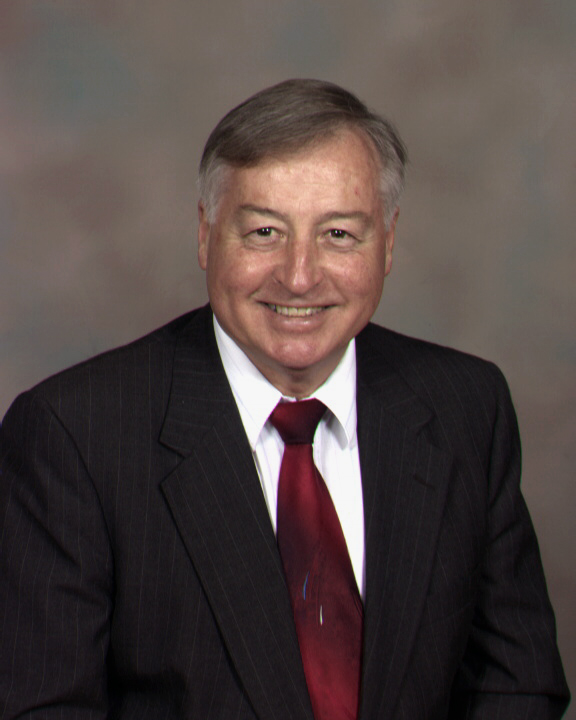
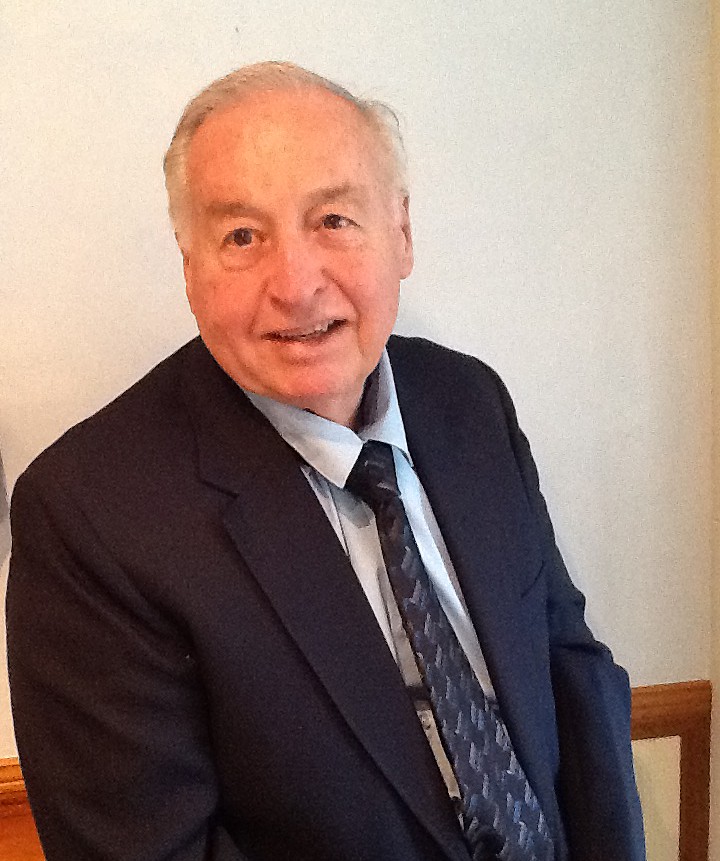
Bro. Paul Bredestege, 88, died on Oct. 4, 2026, in Dayton, OH, with 69 years of religious profession. Brother Paul was a devoted educator, retreat director, mentor, and community leader whose life reflected a deep and joyful commitment to the Marianist mission of teaching, accompaniment, and community building. beloved teacher and professor, linguist, scripture scholar, religious formator, campus minister, and parish priest. Those who knew him remembered an inspirational brother who was habitually joyful, deeply people-oriented, and always ready to say “yes.”
Click here to see pictures of Bro. Paul through the years.
Good to Know
Boo-longing Together
Photo credit to Nayali Aleman
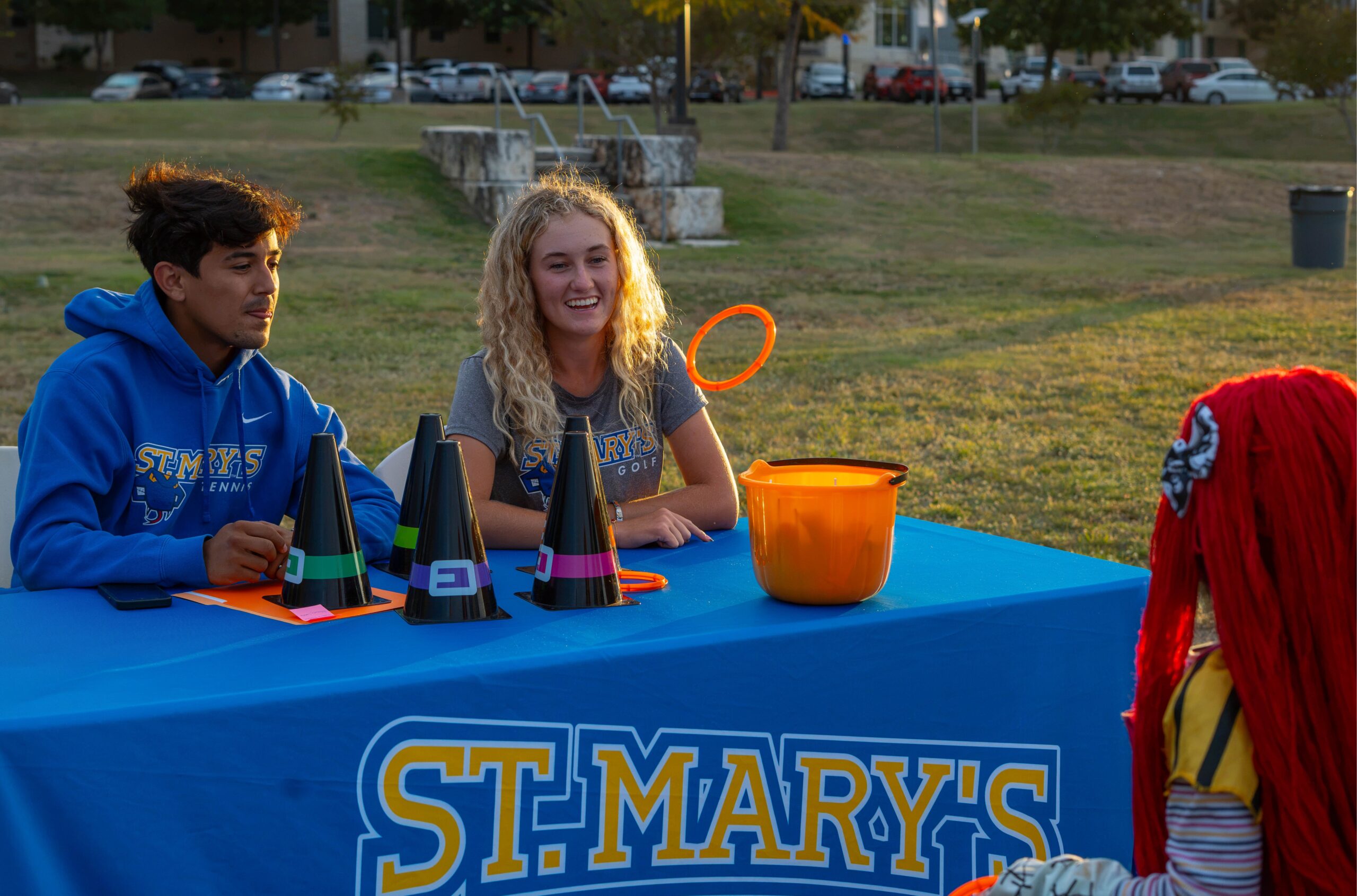
A few boos, plenty of treats, and 35 years of bringing neighbors together! St. Mary’s University (StMU) celebrated a Halloween tradition on Oct. 27, welcoming local families to campus for its annual Boo Bash.
Goblins and ghouls ages 14 and younger flocked to Flex Field for trick-or-treating, games, and family-friendly fun, with volunteers from the StMU community helping make it spooktacular.

Students could earn service hours by donating bags of candy, supporting the university’s goal of completing 10,000 hours of service in honor of Pope Leo XIV. The initiative was inspired by President Winston Erevelles’ trip to Rome and a papal audience.
Rooted in the Marianist spirit of hospitality and service, Boo Bash offered something sweeter than candy: a place for neighbors to feel welcome. That’s a tradition worth keeping alive—one treat at a time.
Celebrate Our Lady of the Pillar in Saragossa Next Year
Join the North American Center for Marianist Studies (NACMS) for an 8-night journey through France and Spain (October 5–14, 2027) to experience where the Marianist Charism came to life.
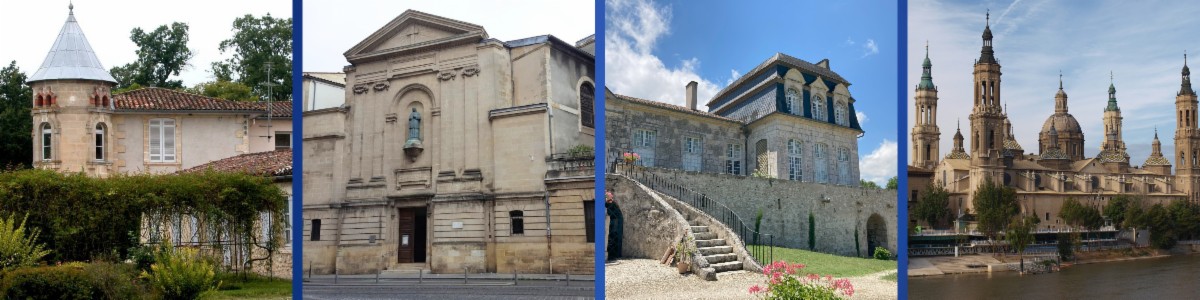
Travel with a Marianist expert who will provide deep context and unique insight into sacred sites. Celebrate the Feast of Our Lady of the Pillar in Saragossa on October 12—praying where Blessed Chaminade did as his vision for the Marianist Family crystallized. Walk the streets of Bordeaux where Marie Thérèse ministered, explore Adèle’s countryside in Agen, and reconnect with your spiritual roots. Click here for more information.
JOIN US!
Click here to discover job opportunities within our Marianist Ministries across the United States.
New listings include:
Marianist Province (MO) – Human Resources Director
Chaminade University of Honolulu (HI) – Asst. Professor in Religious Studies
Check Out More Marianist News
Via Latina from the General Administration of the Society of Mary
Marianist Encounters Newsletters from the Marianist Family Encounters Project
Sharing Our Marianist Stories podcast from North American Center for Marianist Studies
All Things Marian podcast from the International Marian Research Institute
Justice Jottings from the Marianist Social Justice Collaborative
FatherSide Chats is a web video series featuring Fr. Gene Contadino. Discover new episodes every Tuesday about a variety of topics. Click the graphic to view episodes. Click here to read more.
AMU Newsletter from the Association of Marianist Universities
St. Leonard’s Ledger from the St. Leonard Marianist Community
Region Update #106 from the Marianist Region of India
Follow Us On Social Media
FamilyOnline Submissions
We welcome and encourage submissions of interest to our nearly 4,000 subscribers. Please send them to Theresa Petry.
GET CONNECTED!
Stay in touch with the Marianist Province by downloading our new mobile app!
Download your free copy today for easy access to information that supports the work of Marianist-sponsored ministries. Compatible with Apple iOS and Android devices.
The post FamilyOnline October 2026 appeared first on Marianist.