


A Franciscan Gospel Reflection for the Solemnity of the Most Holy Trinity 2026 is here for your prayer. What is your prayer like when you come before God conscious of the heart of God?
The Gospel background and reflection questions are prepared and distributed by Franciscan Sister of Christian Charity Sister Anne Marie Lom, OSF and Joe Thiel, as edited from Reflections authored by Fr. Paul Gallagher, OFM. The excerpts from the Sunday readings are prepared by Joe Thiel. To read or download the complete pdf with excerpts for your prayer, please click here:Franciscan Gospel Reflection May 31 2026
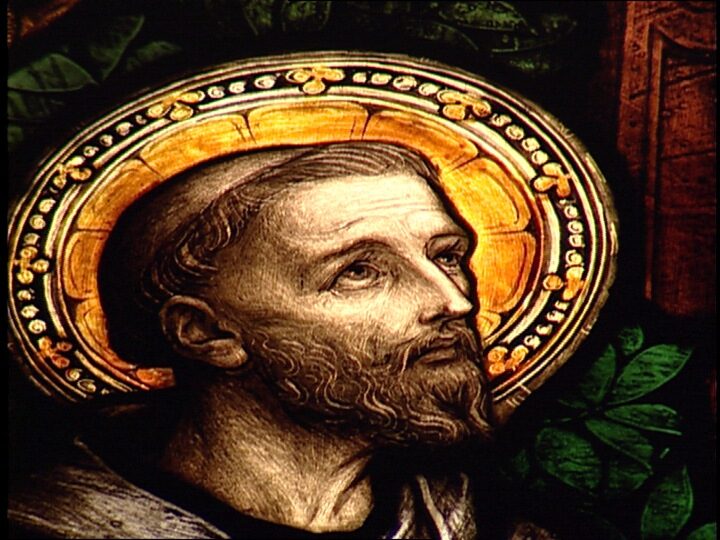
Photos: Franciscan Sisters of Christian Charity St. Francis Chapel; St. John Nepomucene Catholic Church, Little Chute, Wisconsin
John 3:16-18
For God so loved the world that he gave his only Son, so that everyone who believes in him might not perish but might have eternal life. For God did not send his Son into the world to condemn the world, but that the world might be saved through him. Whoever believes in him will not be condemned, but whoever does not believe has already been condemned, because he has not believed in the name of the only Son of God.
Background:
John’s Gospel was written later than the other Gospels, and his community would have been familiar with those Gospels. Therefore, he did not need to include introductory information about the person of Jesus. Instead, his Gospel begins with John the Baptist testifying to the greatness of Jesus, and then it moves directly to Jesus’ call of the first disciples. The second chapter of John’s Gospel describes the wedding feast at Cana and Jesus expelling the merchants from the Temple. Both events would have disturbed the people’s understanding of their relationship with God.
The third chapter of John’s Gospel begins with Nicodemus, a leading Pharisee of the day, coming to Jesus at night to gain a clearer understanding of Jesus and his teaching. Nicodemus asks Jesus, “Rabbi, we know that you are a teacher who has come from God, for no one can do these signs that you are doing unless God is with him.” Jesus answers, “Amen, amen, I say to you, no one can see the kingdom of God without being born from above.” (John 3:2-3) Jesus’ response to Nicodemus uses a word that means both again and above, so that when Jesus tells him that one must be born “again” in order to enter the Kingdom of God, Nicodemus is not sure what he means. It is from within this longer conversation with Nicodemus that today’s short Gospel text is taken.

The text states that God gave his only Son to the world so that everyone who believes in him might have eternal life. In John’s Gospel, “the world” is sometimes cast in a positive light, but more often it is cast in a negative light. The early Christians’ experience of the world changed drastically in those years when the texts that make up the New Testament were being written. In the early years, the Christian movement was largely a segment of the Jewish community. Their daily life was shaped by their Jewish community and religious sensibilities. They were a group within their community that was convinced that Jesus was the long-awaited messiah. They lived by that conviction, and argued with their contemporaries, but they maintained their status in the Jewish community. As gentiles were converted and welcomed into the Christian community, tensions arose within the community between Jewish Christians and non-Jewish Christians. Some Jewish Christians rejected their new faith, resentments arose, and eventually the Christian community was expelled from the synagogues and a more hostile attitude toward the world emerged. This shift in attitude is also reflected in John’s Gospel and elsewhere within the New Testament.
The first verse of today’s Gospel is among the most familiar texts in the Christian Scriptures. Reginald Fuller, a well-respected scripture scholar, says that this one statement is “a succinct summary of the whole Gospel…” The text states succinctly that God is motivated by love to give us his Son, so that everyone who believes in him might have eternal life. God’s giving here includes both God giving his Son in the incarnation and also the giving of his Son in the crucifixion. God’s intention and desire is clear, that we might have eternal life. The text also addresses those who do not accept the Son. They bring judgement upon themselves; it is not God who judges them or rejects them. They choose to either accept God’s desire to share eternal life with them or reject God’s desire for them.
Reflection Questions:
- Complete this sentence: My parents so loved me that they gave me
- Take a few minutes to think about how you and people around you have used the word “world.” What was meant by that word?
- Place yourself in the presence of when God decides to send his Son into the world. How would you describe that scene? How does God’s desire come through to you? What is your reaction?
- What has been your primary experience of the world and society?
- Have there been periods in your life when it has been difficult to believe in the goodness of the world, creation, and the people around you? What happens to you when you choose to live out of that attitude?
- How is your life different when you live out of a basic reverence, trust, and sense of love that is in harmony with God’s desire?
- God so loved that world that… (How many different ways could you complete this sentence?)
- The text seems to invite us to contemplate and enter the heart of God. What do you think it would be like to see yourself through the eyes and heart of God?
- What is your prayer like when you come before God conscious of the heart of God?
- Can you take some time to talk openly and honestly with God about how you feel about the world right now, how you would like to feel about the world, and what grace you need from God to approach the world as God approaches the world?
The post Solemnity of the Most Holy Trinity 2026 Franciscan Gospel Reflection appeared first on Franciscan Sisters.